A stiff, painful shoulder that will not move — frozen shoulder — treated at Medifirst Hospital mostly with physiotherapy and a targeted injection. The great majority recover fully, without surgery.
Medically reviewed by Dr. Kumar Vishal
Pride of Jharkhand 2025
Dr. Kumar VishalFrozen shoulder & joint care · Medifirst
Thirteen years of trauma, joint and sports surgery — and patients who walk out of it.
Frozen shoulder (adhesive capsulitis) is when the lining of the shoulder joint tightens and inflames, so the shoulder becomes painful and stiff. It is common in people with diabetes and after an injury. It settles almost always without surgery — with the right physiotherapy and, when needed, a steroid injection — though it can take a few months.
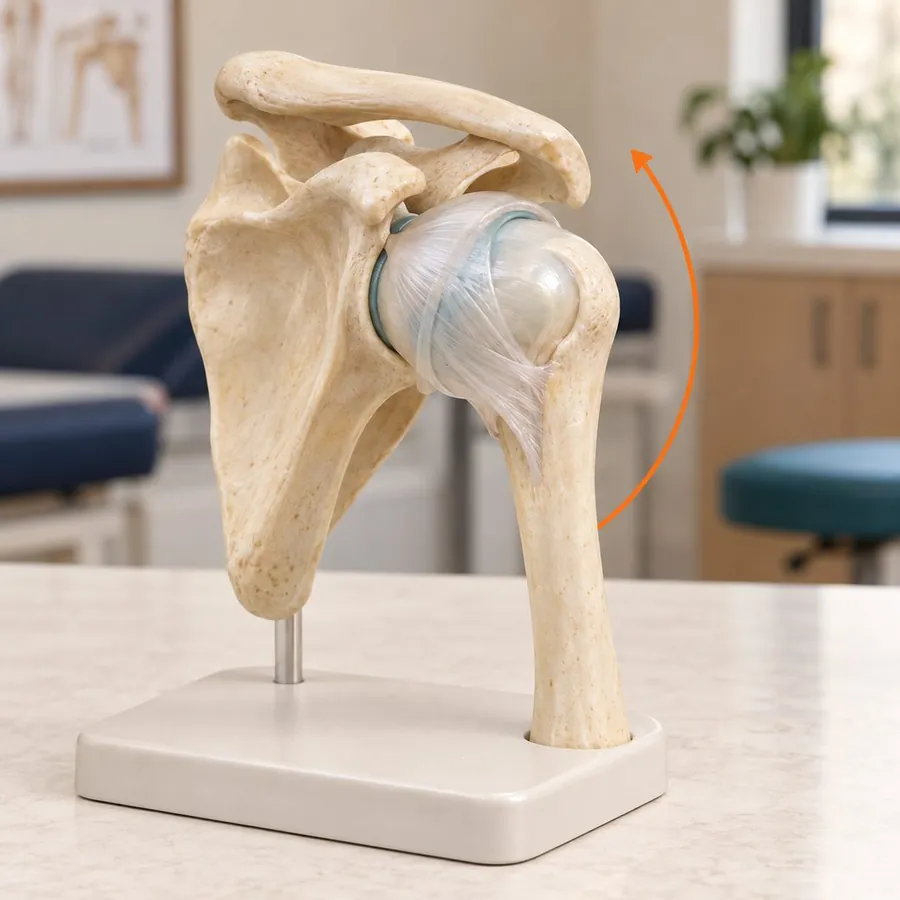
The shoulder joint is wrapped in a soft capsule. In a frozen shoulder, that capsule becomes inflamed, thickened and tight — gripping the joint so it hurts and will not move freely. It often comes on for no clear reason, and is much more common in people with diabetes or after a period of not using the arm.
It typically passes through three phases — a painful freezing stage, a stiff frozen stage, and a thawing stage as movement returns. The reassuring part is that it almost always recovers; the right treatment makes it far less painful and much faster.

A frozen shoulder builds gradually. See a specialist if these ring true — early treatment shortens it and eases the pain.
Not sure if you even need surgery? Send your X-ray on WhatsApp for an honest opinion.Just attach a photo of your X-ray in the chat.
The diagnosis is usually clear from the examination, with an X-ray or MRI mainly to rule out other causes. Treatment focuses on breaking the pain-stiffness cycle: settling the pain with medication and, where it helps, a precise steroid injection, so that physiotherapy can do its work.
A guided stretching and physiotherapy programme then gradually restores movement — the single most important part of recovery. For diabetics, controlling blood sugar helps the shoulder recover. Surgery (a manipulation or keyhole release) is reserved for the rare shoulder that stays stuck despite all of this.
Dr. Vishal walks you through your own X-ray or MRI, shows you exactly what's going on, and lays out every option — surgery and non-surgery — so the decision stays yours.
Frozen shoulder recovers in stages — steadily, and almost always without surgery.
Medication and a steroid injection where needed calm the pain so movement can begin.
Guided physiotherapy and home stretches gradually loosen the tight capsule.
Range and strength come back over weeks to months as the shoulder eases.
The great majority regain a comfortable, freely moving shoulder.
A frozen shoulder almost never needs surgery — but it does need the right, guided treatment. Dr. Kumar Vishal is an orthopaedic and trauma surgeon in Ranchi, Jharkhand, practising at Medifirst Hospital, where he is Director. Choosing an orthopaedic surgeon is one of the most important health decisions a family makes — and for thousands across Jharkhand, that choice has been Dr. Vishal.
With more than 13 years of experience and 800+ surgeries performed, he is widely regarded as one of the best orthopaedic surgeons in Ranchi for knee & hip replacement, arthroscopy, sports injuries, arthritis and complex trauma & fracture care. He is fellowship-trained in joint replacement and arthroscopy and has treated over 10,000 patients — including fractures other hospitals had turned away.
What sets him apart is a philosophy of honest, unhurried care — every patient examined personally, given a clear explanation, and told plainly whether surgery is truly necessary, or whether physiotherapy, medication or rest would serve them better.
240+ reviews posted publicly on Google — names shown as they appear there. We never invent testimonials.
"Dr. Kumar Vishal is an exceptional orthopaedic surgeon. I suffered a hand fracture and he handled everything professionally, from the X-ray to the plastering. The recovery was surprisingly quick and smooth. I'm extremely grateful for his expertise and care."
Read on Google"I had ongoing pain in my left hip joint, but the X-ray was normal so no one could find the cause. Dr. Vishal explained the difference between a nerve problem and a bone problem, and examined it properly. I'm much better now, and the problem is nearly gone."
Read on Google"My brother had a leg fracture. Another hospital kept him in ICU for a week and was running up unnecessary bills. Dr. Vishal read the reports, explained there was no abdomen or head injury, operated on the fracture — and 10 days later my brother is comfortable. His advice is genuine."
Read on GoogleStill have questions? Talk to Dr. Vishal's team — bring your reports, leave with a plan.
This page is general educational information, not a substitute for a personal consultation. Individual results and recovery vary; a treatment plan is decided only after examination.
Get a straight answer on your pain — and a clear plan to fix it. Share your reports or message on WhatsApp, and Dr. Vishal's team helps you book the right time and clinic, often the same day.